The Story
The Trained Artist Who Chose Public Access
Damon Zex held an MFA in performance art and used it to turn a late-night Columbus cable channel into a laboratory for the strange, the beautiful, and the deliberately unbearable.
I
The Formation
Frederick Steven Zaner was born in Columbus, Ohio, on July 11, 1963, and the city never really let him go — Columbus was his home and his stage for his entire career. The man it would come to know as Damon Zex was, first, a student of art: a bachelor's degree from The Ohio State University in 1985, and then, in 1991, a Master of Fine Arts in Multi-Media Performance Art from the same university.
That credential matters more than any single sketch he ever taped. Zex was not an accidental weirdo with a camcorder; he was a formally trained fine artist who chose public access as his medium. The tension between "trash TV the suburbs couldn't stomach" and "rigorous conceptual artist" is the most interesting thread in his whole story — and the MFA was not a footnote. It was, quite literally, how he would later out-argue the Columbus City Council.
Before the persona hardened into something the whole city debated, he worked the ordinary jobs of a young artist in a mid-sized capital: a sales rep for an art-products company, a gallery director, a designer for a glass studio and a local arts magazine. By 1992 he had found the room that suited him — videographer and technical director at Community 21, the public-access operation that would carry Zextalk. He would later co-own Damon Zex Ltd., serve as an expert art witness in U.S. Federal Court in 1999, and earn a listing as a notable artist in Marquis Who's Who. The résumé reads, deliberately, like that of a working professional. That is exactly the point.

II
The Persona & the Aesthetic
Onscreen, Zex was a goth, decadent figure — one writer reached for "a Robert Downey Jr. lookalike" as shorthand. But the costume was stretched over a genuinely catholic set of influences. He claimed, and critics assigned him, a lineage that ran from Georges Méliès and the silent comedians — Chaplin, and the deadpan television surrealism of Ernie Kovacs — through Kenneth Anger and Andy Kaufman, German Expressionism, and the harder surrealism of Beckett and Breton.
What kept the provocation from curdling into mere shock was a yogic perspective he held on his own art and life. It is the reason that, when he was attacked, he never returned personal fire — he defended the art form on principle instead of defending himself.
His enthusiasms were real and wide. He is reported to have taken up chess at the age of five and to have won a state championship before renouncing competitive play — the seed of his late film Checkmate — and he kept up yoga, dance, astrology, weight training, and philosophy besides. He posted aphoristic, system-building ideas online, and he meant every one of them.
“The axioms establishing any universe can be reduced to the six categories of judgment.”
He thought of himself, without irony, as a Renaissance polymath — "Thinker, Writer, Artist, Actor," a self-described "true Renaissance Man." The most useful thing a viewer can do is take that self-understanding seriously.
III
The Show
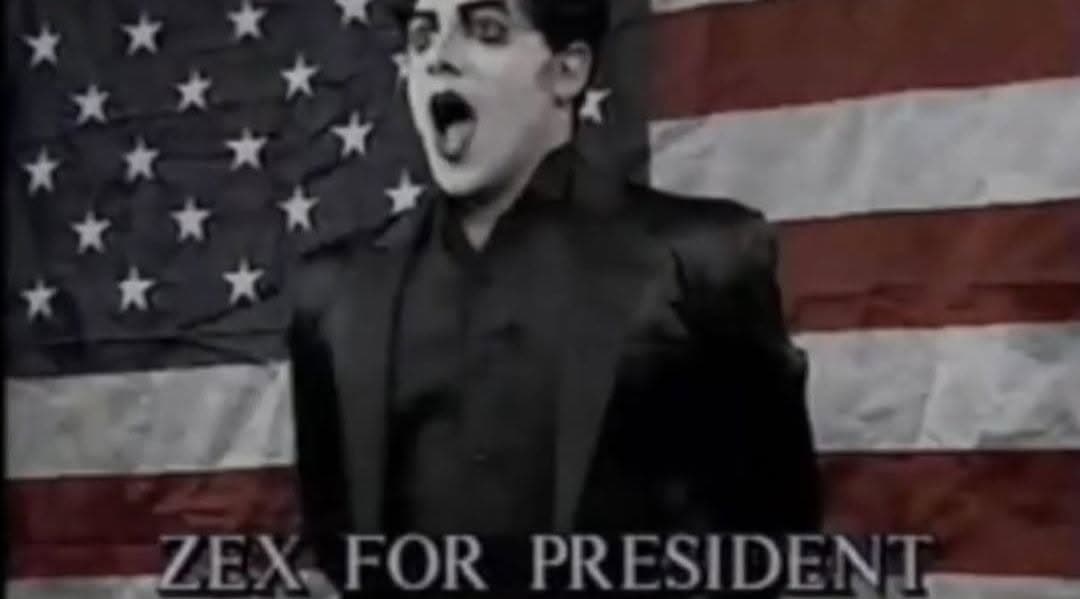
Zextalk arrived on Columbus public access in 1992 and, by every account, crashed like a bolt of lightning — turning up on the same low channels as gentle local fare like Bee B The Clown and detonating there. It was produced at Community 21, where Zex himself worked the cameras and the switcher.
The show was an anthology: sketches, monologues, recurring characters, and surreal set-pieces, assembled with an obvious and abiding love of silent film and German Expressionism. The high-contrast black and white, the pantomime, the title-card grammar of the silent era — these were not affectations but the actual language Zex was working in. For twelve years, until the channel itself went dark in 2004, Zextalk was where that language lived.
IV
The Public-Access Wars
Zextalk did not stay a cult secret for long. It drew the attention — and the ire — of the Columbus City Council, and, as reported, of national television beyond it: his work is said to have been attacked across three consecutive days on CNN's Headline News feed, and he was covered by the tabloid talk circuit of the era, from Geraldo to Jerry Springer to Howard Stern. After Columbus public access ended, his tapes reportedly traveled further still, airing internationally on the UK's Channel 4 and the BBC — which is said to have run Breakfast with Damon Zex — and on UK ShockVideo.
What makes the episode historically interesting, rather than merely lurid, is what the city did next. Because Zex held an MFA and could defend his work fluently in the language of art theory, the City Council convened a cable advisory commission specifically to deal with him. He kept showing up to its meetings — not to defend himself, but to defend public access as a medium. To his surprise, supporters began showing up to defend him.
The critic Alfred Eaker later framed the whole affair as a small-scale "Degenerate Art Show" — a status-quo institution straining to suppress avant-garde work it could not categorize. Zex, for his part, called the council "New Age Nazis." Underneath the tampon gags and the chessboards built from drugs, it was a genuine free-expression fight: one artist against an institution that wanted him gone.
Columbus public access was shut down in 2004. The official targets were obscenity complaints aimed at other shows, not at him — but the effect was the same, and the era was over. Zex, crucially, got out with his master U-Matic tapes intact. That single act of preservation is the only reason any of the work survives to be archived at all.
V
The Late Work
When the channel went dark, Zex did not. His practice simply migrated online, and there it turned increasingly literary and conceptual — the side of him the "tampon-and-chessboard" accounts miss entirely. On a LiveJournal he called ZexArt, he wrote, in effect, a manifesto: "I, Damon Zex, am a conceptual artist," framing a years-long experiment in living and working inside cyberspace.
He was serious, and systematic. He cited his MFA thesis — "The Development of Symbolic Models and Their Extension into Space" — and built out a genuine, outré cosmology: cyberspace as a contemporary astral plane, human beings becoming "techno-organic beings," the networked computer slowly coming to life by studying how people choose. Alongside the theory ran dense, punning prose-poems — word-collages closer to Burroughs and Joyce than to anything on late-night cable.
On a companion site the work took narrative and scripted forms: a self-mythologizing reinvention story, and Zextalk itself reimagined as text, its invented characters trading hermetic dialogue on the page. Taken together, the late writing is the through-line that proves the point — the trained conceptual artist had been underneath the shock all along. It has its own room in The Work.
VI
Legacy
The work's most serious critical champion was Alfred Eaker, who in 2009 devoted two essays in 366 Weird Movies to the case for Zex as an artist of real rigor. Eaker placed him in a line of descent from Méliès, Kenneth Anger, and Ernie Kovacs, and heard a Mahlerian sensibility beneath the provocation. Eaker died in 2023; his advocacy is now part of the record it helped create.
Recognition widened beyond Columbus. Brooklyn's Spectacle Theater programmed Zex in its 2019 series "Public Access, Private Desires" — setting him among a national canon of access auteurs that included David Liebe Hart, Concrete TV, Harvey "Job" Matusow, and Splendid Recipes — and brought the work back for an encore in January 2025. Marquis Who's Who had already listed him among notable artists.
But the truest measure of him is smaller, and more durable, than any retrospective.
“If you ask just about anyone who lived in Columbus at the time, they have at least one Damon Zex story.”
Everyone, it turns out, has one. This is where they can be kept — add yours.